Discombobulator™ — drone-mounted HPM directed-energy counter-drone system
A compact, AI-driven, drone-mounted high-power microwave (HPM) directed-energy weapon — the first HPM system small enough to ride a tactical drone yet powerful enough to disable radars, electronics, and suicide drones from standoff range.

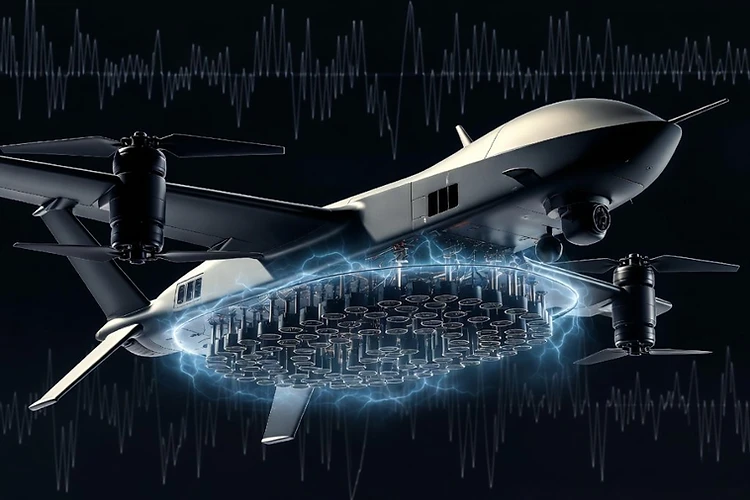
The Discombobulator™ HPM is the first operationally ready counter-drone system for attack drones and military drones — a compact airborne electronic warfare system that disables radars, electronics, and suicide drones from standoff range, the directed-energy core of counter-UAS and counter-drone defense.
A complete electronic warfare system
A high-power microwave weapon generates intense, narrowband electromagnetic pulses in the 2–6 GHz range. When these pulses couple into a target's antennas, leads, or enclosure seams, the induced currents exceed semiconductor damage thresholds — producing effects from transient upsets (lock-ups, reboots) to permanent junction failure. Unlike a nuclear EMP (wideband, single event), the Discombobulator™ is a reusable, agile-frequency, narrowband emitter that can engage multiple targets in sequence with tailored waveforms. It is a directed-energy weapon, not a blast weapon.
System architecture
Drone bus 48 V DC → 1 kV intermediate stage, capacitor bank buffer
Miniaturized Marx generator, 600 kV pulse, 50 ns rise time
5 MW-class magnetron or vircator, 2–6 GHz agile
64-element phased array, ±45° electronic steering
YOLOv8 + RF fingerprinting on Jetson Orin, <200 ms detect-to-engage
Deployment constraints
All-up weight 12–35 kg and 300–800 W average draw — bounded by Group 3 drone payload capacity.
Pulsed duty cycle capped at ~5% to keep magnetron anode below 150 °C without liquid cooling.
Microwave coupling degrades sharply through dense terrain; clear LOS to target antenna required.
Agile band must be deconflicted with friendly radar and comms before emission.
Each target class pre-cleared for proportionality; permanent damage modes require operator consent.
Heavy rain attenuates 2–6 GHz by <1 dB/km; engagement ranges reduce in monsoon conditions.
Comparison to legacy HPM programs
| System | Platform | Weight | Frequency | Shots | Onboard AI |
|---|---|---|---|---|---|
| Boeing CHAMP (2012) | Cruise missile | 1,000+ kg | Fixed | Single-shot | No |
| AFRL HIJENKS | Aircraft pod | 800–1,000 kg | Fixed | Multi-shot | Limited |
| Raytheon Phaser | Ground array | Track-mounted | Agile | Multi-shot | Yes |
| Epirus Leonidas | Ground container | 2,000+ kg | Agile | Multi-shot | Yes |
| Discombobulator™ | Drone pod | 12–35 kg | 2–6 GHz agile | Multi-shot | Yes |
The battlefield has changed — electronics are the center of gravity
Future conflicts will be decided not by explosive power, but by the ability to shut down sensors, communications, and control networks before they can react. The Discombobulator™ is the first operationally ready HPM weapon compact enough to be carried by tactical drones — and powerful enough to disable hardened air-defense radars, command centers, and vehicle fleets from standoff ranges. The same HPM pod functions as an anti-drone system and counter-UAS capability — disabling suicide drones, loitering munitions, and attack-drone swarms at the speed of light, without kinetic interceptors.

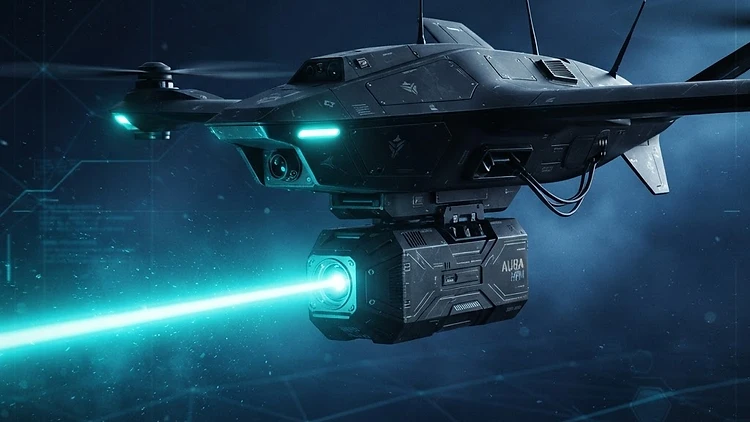
Prime power budget — MALE-class drone
Total power available: 8 kW (engine-driven generator). HPM payload allocation: 5 kW (after flight systems). Onboard battery capacity 10–20 kWh (Li-ion), 50–200 full-power pulses before recharge, 10–30 min sustained operation at 1 Hz PRF.
| Parameter | Value | Notes |
|---|---|---|
| Capacitor bank charge power | 2–5 kW | Prime power draw |
| Charge time per pulse | 0.5–2 s | Depends on PRF |
| Stored energy per pulse | 500–2000 J | Capacitor bank |
| Pulse compression ratio | 10⁶:1–10⁸:1 | Marx generator |
| Peak output power | 100 MW–1 GW | At antenna feed |
| Pulse width | 10–100 ns | FWHM |
| Effective radiated power (ERP) | 5–50 GW | With antenna gain |
| Pulse repetition frequency | 1–100 Hz | Variable |
Notional power budget for seminar discussion purposes.
Frequently asked questions
Non-kinetic. It uses high-power microwave pulses to upset, disrupt, or permanently damage semiconductor-based electronics — no explosive warhead, no shrapnel, no kinetic interceptor. Effects scale from temporary data corruption to permanent dielectric breakdown depending on field strength and target hardening.
Effective radiated power reaches up to 50 GW with antenna gain, and the engagement range extends to 15 km under line-of-sight conditions. Peak output power at the antenna feed is in the 100 MW–1 GW class, with pulse widths of 10–100 nanoseconds.
Each target class is pre-cleared for proportionality. Permanent-damage modes require operator consent, and the agile frequency band is deconflicted with friendly radar and communications before emission to minimize collateral effects.
The onboard AI (YOLOv8 + RF fingerprinting on Jetson Orin) handles detection and classification in under 200 ms, but permanent-damage engagements require operator consent. The system compresses the kill chain to under 3 seconds against moving swarms while keeping a human in the loop for lethal effects.